CONCRETE TAKEOFF · STEP-BY-STEP GUIDE
Work out concrete volume for a straight stair flight
See how risers, treads, stair width, and an optional landing affect a solid-flight estimate, then check the result in cubic feet and cubic yards.
Featured image credit: Becca Tapert / Unsplash.
First define the stair geometry
A volume takeoff needs a consistent stair layout: the number of steps or risers represented in the model, riser height, tread depth, stair width, and any landing dimensions. This guide follows a straight, solid stair-step profile with an optional rectangular landing, as described on the tool page.
Use the dimensions from approved drawings. Riser and tread geometry, reinforcement, support, landing connections, and local code requirements are design matters; a volume estimate does not verify them. If your stair includes a separate waist slab, beam, void, or unusual shape that is not part of the solid profile, account for it separately with the project designer.

Construction image: d c / Unsplash.
The solid step-profile formula
For a flight of n equal steps in a solid stair-step profile, the cross-section is the sum of progressively taller step blocks:
Flight volume = width × tread depth × riser height × [1 + 2 + … + n]
Since 1 + 2 + … + n = n(n + 1) ÷ 2, the same formula is width × tread × riser × n(n + 1) ÷ 2. Add an optional rectangular landing as landing width × landing length × landing thickness, if those are the dimensions requested by your plan and the calculator inputs.
Use the same units for every dimension. With feet, the result is cubic feet; divide by 27 to convert to cubic yards. Keep the unrounded result until you apply any stated allowance.
Calculate it step by step
Step 1: Confirm the step count and measurements
Check whether the drawing and calculator use the same count convention for steps and risers. Record the specified rise, tread, and finished width. Do not estimate stair dimensions from a photograph or from a general online example.
Step 2: Convert inches to feet
Divide inch measurements by 12 before combining them with dimensions in feet. For example, a 7-inch rise is 7 ÷ 12 = 0.5833 ft. This keeps the volume calculation dimensionally consistent.
Step 3: Calculate the solid flight volume
Multiply width, tread depth, and rise by the sum of the step levels. This represents a solid stepped profile. If your stair design uses a different structural shape, use its specified concrete sections rather than treating the whole flight as a solid block.
Step 4: Add the landing and any stated allowance
Calculate a rectangular landing separately and add it only once. Apply the waste or placement allowance entered in the tool after adding the modeled flight and landing volumes. Confirm the final order unit and rounding with your concrete supplier.

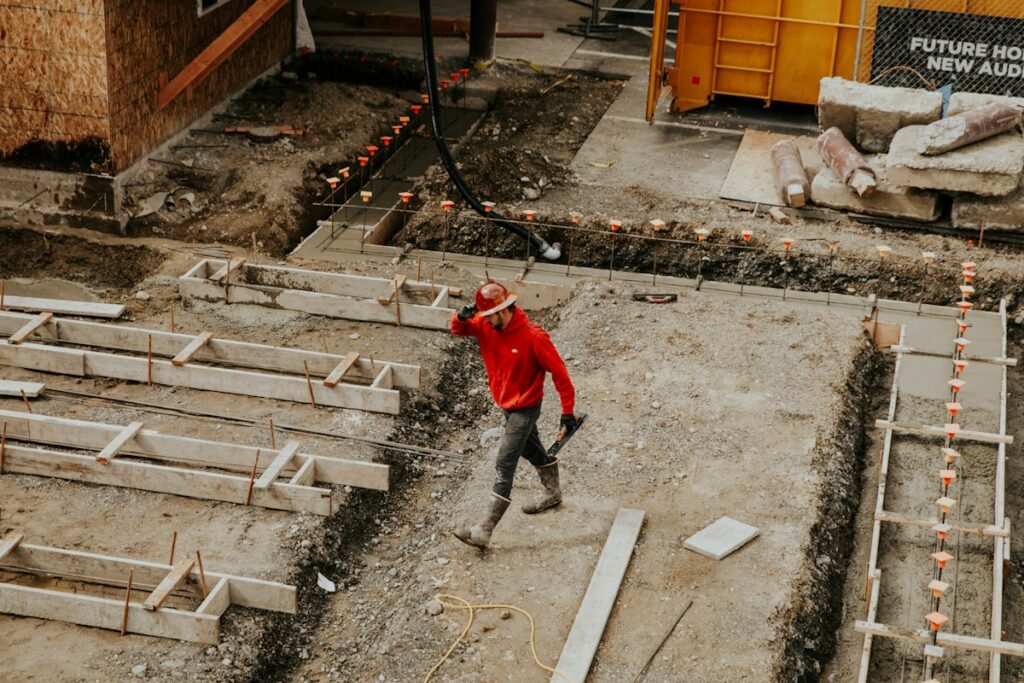
Worksite image: Mr Xerty / Unsplash.
Worked example: four equal steps with a landing
Assume four step levels, a 7-inch rise, an 11-inch tread, and a 3 ft width. Convert rise to 0.5833 ft and tread to 0.9167 ft. Flight volume = 3 × 0.9167 × 0.5833 × (1 + 2 + 3 + 4) = about 16.04 ft³ (0.594 yd³).
For an example 3 ft × 4 ft landing with 6-inch thickness (0.5 ft), landing volume = 3 × 4 × 0.5 = 6 ft³. The combined base is 22.04 ft³ (0.816 yd³). With a 5% example allowance, it becomes about 23.14 ft³ (0.857 yd³).
This is a transparent arithmetic example for the solid step-profile model, not a stair design or universal allowance. Match the count convention and dimensions used by your calculator and project documents.

Staircase image: Stéphane Mingot / Unsplash.
Before you order concrete
Check that the plan’s step count matches the calculation, all dimensions use one unit system, and the landing is not already included in another takeoff. Confirm whether your stair is a solid profile or includes a separate structural slab, beam, or void. Ask the supplier about delivery increments and the yield of any premix bags.
If your stair is suspended, curved, split into multiple flights, or has a non-rectangular landing, a qualified estimator should take off the concrete from the structural details. The simple model is most useful when its assumptions match the actual formwork.
Check a straight flight and optional landing
Enter the stair dimensions from your plans, include the landing when applicable, and compare cubic feet, cubic yards, and bag estimates.
Frequently asked questions
Does this method estimate a straight stair flight?
The example formula describes a straight solid step profile with uniform risers and treads. Confirm the calculator’s inputs and your plan use the same model before relying on the result.
How do I include a landing?
Calculate a rectangular landing as width × length × thickness, using consistent units, then add it once to the flight volume if it is not already included in the modeled flight.
How do I convert the stair volume to cubic yards?
When the dimensions are in feet, divide cubic feet by 27. The calculator can also provide the volume in the units shown on its results panel.
Does the estimate design safe risers and treads?
No. Use the stair geometry, reinforcement, and dimensions specified by the design professional and applicable code. The volume result is a material estimate only.
How many premix bags does the flight need?
Divide the adjusted volume by the published yield per bag for your selected mix and round up. Bag yields differ by product and package size, so use the manufacturer’s label.
Construction conditions and local requirements vary. Confirm important quantities and specifications with your drawings, supplier, and qualified local professional.