FOUNDATION PLANNING · CONCRETE TAKEOFF
Estimate footing concrete from the dimensions on your plans
Learn the volume formulas for rectangular pads, continuous footings, and round piers, then allow for waste and convert the result into a practical order quantity.
Featured image credit: Becca Tapert / Unsplash.
Begin with the footing schedule, not a guess
Footings transfer building loads into the ground, so their size and depth belong to the project design. Use the dimensions and quantities shown on approved drawings or the footing schedule. This guide helps estimate concrete volume; it does not size or design a foundation.
For a clear takeoff, group footings by shape and dimensions. Calculate each group, add the volumes, and then apply the project’s stated placement allowance. Keep separate notes for pads, continuous runs, and round piers so you can check the total later.

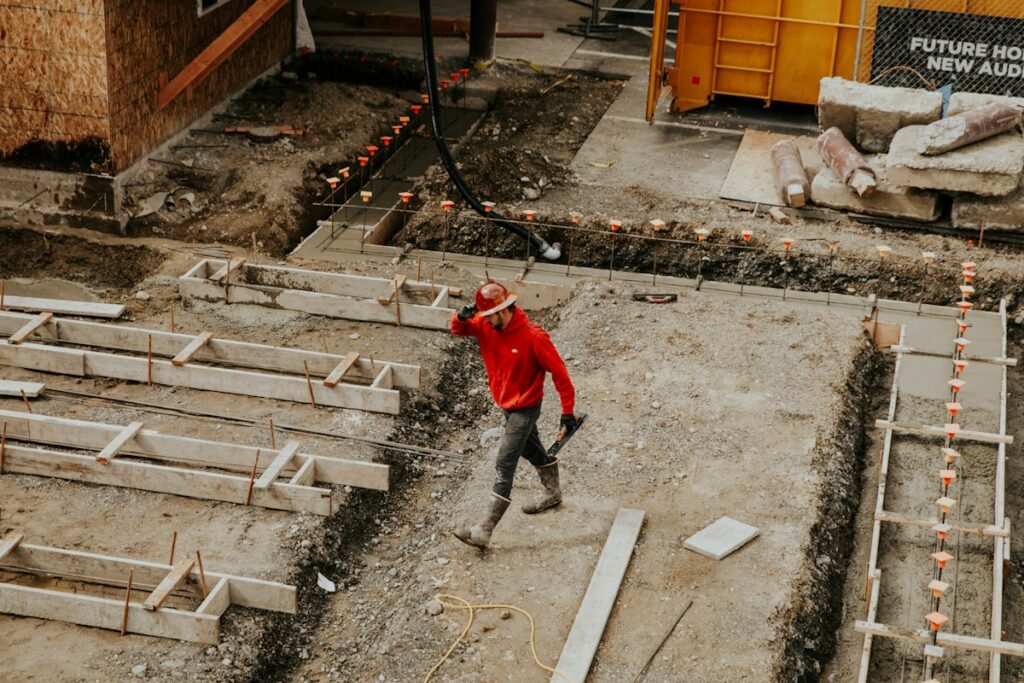
Construction-site image: Di / Unsplash.
Footing volume formulas
Rectangular pad: length × width × depth × number of identical pads.
Continuous rectangular footing: total measured run × footing width × footing depth. Measure the run consistently and avoid counting overlapping corners twice.
Round pier: π × (diameter ÷ 2)² × depth × number of identical piers.
Use one unit system for every dimension. With feet, these formulas produce cubic feet; divide by 27 for cubic yards. Convert inches to feet by dividing by 12 before multiplying. For mixed sizes, calculate each group separately and add the results.
A step-by-step concrete takeoff
Step 1: Read the footing dimensions and count
Record each footing’s shape, length or diameter, width, depth, and quantity. Take dimensions from the project drawings. If depths or widths vary along a run, split the run into sections with uniform dimensions.
Step 2: Convert all measurements to the same units
Convert inches to feet or use another consistent unit set before calculating. A common error is multiplying feet by inches without converting; that leaves the volume off by a factor of 12.
Step 3: Calculate each shape on its own
Use the rectangular formula for pad and strip sections and the circular formula for round piers. Add the individual base volumes only after each group has been checked.
Step 4: Add the specified allowance and review the order unit
Apply a waste or placement allowance only when appropriate for the project and ordering method. The allowance adjusts the estimate; it does not change the designed footing dimensions. Confirm whether your supplier quotes ready-mix by cubic yard or bagged concrete by stated yield.

Building-project image: Ray Donnelly / Unsplash.
Worked examples
Three rectangular pads
Each pad is 2 ft × 2 ft × 1 ft. Base volume = 2 × 2 × 1 × 3 = 12 ft³, or 0.444 yd³. With a 5% example allowance: 12.6 ft³, about 0.467 yd³.
One round pier
A 1.5 ft diameter pier, 3 ft deep: π × 0.75² × 3 = about 5.30 ft³, or 0.196 yd³. With a 5% example allowance, that is about 5.57 ft³ (0.206 yd³).
The allowance percentages above are arithmetic examples, not a recommendation for every site. Use your project specification and supplier’s guidance.

Footing-site image: Ricardo Gomez Angel / Unsplash.
Bag yield and delivery checks
For bagged mix, divide the adjusted volume by the published yield per bag, using the product’s stated yield and matching units. Round up to whole bags. For ready-mix, ask the supplier how to round the order and whether the quoted volume is batched or delivered.
Check that excavation and formwork dimensions match the drawing before ordering. Over-excavation, soft soil, obstructions, and site conditions can affect the placed quantity; resolve those conditions with the project lead instead of silently changing the design size.
Check your footing quantities
Enter the approved footing dimensions, quantities, and allowance to compare rectangular and circular concrete volumes.
Frequently asked questions
How do I calculate concrete for several footings?
Group identical footings, calculate the volume for one, multiply by the count, and add the totals for the other shapes or sizes. Keep each group separate in your notes.
How do I calculate a circular footing?
Use π × radius² × depth. If you have the diameter, divide it by two to get the radius, then multiply by the number of identical piers.
How do I convert cubic feet to cubic yards?
Divide cubic feet by 27. Keep the unrounded figure through the calculation and round the final order quantity according to the supplier’s rules.
Does this estimate determine footing size?
No. Use the dimensions specified by the project designer or approved drawings. A volume estimate is not a structural design or a code review.
How many premix bags will I need?
Divide the required volume by the yield stated on the bag for the mix you are buying, then round up. Bag yield varies by product and package size.
Construction conditions and local requirements vary. Confirm important quantities and specifications with your drawings, supplier, and qualified local professional.